
Most trade show booths look like they were designed by committee and approved by no one who’s ever actually walked a trade show floor. Unsurprisingly, it results in a lot of noise but very few actual conversations.
That’s the gap. How slick your booth design is going to look shouldn’t be the top of your worries. Your main objective must be to get strangers to stop, care and stay long enough that they turn into warm leads you can later follow up to.
That takes choices, intentional ones. In this guide, you’ll get 25 trade show booth design tips that turn heads and, if executed right, win you more business.
Expo Booth Design Tips Before the First Sketch
Your first step is to establish strategy.
Before your team opens a design app or calls a vendor, you need to be crystal-clear about what the booth is supposed to do. These next few best practices help lay the groundwork.
1. Define the single most important thing visitors should remember
That said, it’s neither your full product suite nor your company history. Just one thing.
If they remember only one sentence about you, what should it be? Everything else serves that.
2. Build around your goal
It has to make sense with your primary business goal. That can be lead generation, scheduling demos or building brand awareness buzz. Either way, your booth should guide trade show attendees toward that very goal. If your branding gets in the way of that journey, it’s not helping.
3. Plan for behavior
Most of those exhibiting at a trade show don’t factor this in, but you should: planning for where people will stand, what will they see first, where’s the flow, etc. A beautiful booth that creates bottlenecks or awkward silences fails. Doesn’t matter how well it photographs.
4. Design for engagement from 10, 5 and 1 feet away
At 10 feet, you’re trying to get them to pause. At 5 feet, they’re deciding if it’s worth approaching. At 1 foot, the experience should already be unfolding.
Unfortunately, most booths already fail at step one.
5. Give your booth visitors something to do
Here’s the deal: movement draws interest and interaction builds memory. Whether it’s a touchscreen, a configurator or a live demo they can control, make them not just a bystander but a part of the booth.
Best Practices to Make the Most of a Small Booth Footprint
Not everyone has the budget or space for a sprawling island setup, which is perfectly fine. Smart design decisions can make a 10×10 inline booth feel like the busiest in the building.
Let’s show you how.
6. Go vertical to maximize visibility
When you don’t have floor space, you need air space.
Use tall banners, shelving or mounted screens to lift your message above eye level. Height catches attention from across the aisle.
7. Eliminate anything that doesn’t invite interaction
Make the most of every square inch. If a piece of furniture or a trade show display doesn’t spark engagement, lose it. Clutter kills energy. Keep it open, purposeful and visitor-focused.
8. Use lighting to carve out space
A few well-placed spotlights or LED accents can make your small booth stand out like a stage. Besides adding dimension, lighting also guides attention and creates mood without eating into physical space.
9. Ditch the table in front of your booth
Not that you need to ditch it altogether, but tables between your team and the audience act as barriers. Our tip: push tables to the side or the back. Let people walk in and become part of the trade show experience rather than standing at the perimeter.
10. Use one strong focal point
You don’t need to say everything at once. Incorporate one bold message or feature to magnetically pull potential customers in. That could be a touchscreen demo, interactive display or giveaway wheel.
Complexity repels; clarity converts.
Designing a Booth for Movement and Flow
It’s easy to fixate over how your booth looks in a mockup. But once it’s live on the trade show exhibit floor, the real question is: can people move through it comfortably?
Flow > flair.
11. Keep entrances wide and open
Don’t block the entry point with banners, tables or furniture. A wide, unobstructed entrance invites visitors in. Narrow or cluttered paths make people pass by without stopping.
12. Design your booth in functional zones
Create distinct zones: a welcome zone, a demo area, a conversation space.
Don’t think “where do we put this table?”, think “what do we want people to do here?”
13. Let people browse without pressure
People HATE being cornered. With this in mind, design your booth in such a way that they can explore without instantly being sold to. When they feel safe to browse, they stay longer and start asking legitimate questions.
14. Place interactive elements toward the front
Got a cool interactive display? Put it where passersby can see others using it.
Movement draws more movement. When people stop and interact, it signals that something’s worth checking out.
15. Create visual pathways with flooring or lighting
Subtle changes in carpet color, directional lighting or even vinyl floor graphics can guide where people walk and look. It’s psychology through design.
Making Your Trade Show Booth Presence Interactive and Memorable
People rarely if at all remember static posters or brochures. They’re likely to remember what they touched, built or laughed about. Interactivity is your edge.
16. Consider using touchscreens for self-guided demos
Let visitors explore your product or service of their own volition and at their own pace. A giant iPad-style display with intuitive navigation is a magnet. It turns browsing into brand discovery.
17. Build a challenge or quiz into the experience
Gamification ≠ cheesy giveaways.
A timed challenge, quiz or problem-solving station tied to your product can create buzz and bragging rights. Bonus if there’s a leaderboard.
18. Offer something they can personalize
Let trade show visitors build their own version of your product. You can also have them create a mock solution or select custom configurations. By enabling people to shape their own experience, they stick around and remember you later.
19. Create an Instagram- (or LinkedIn-post-) worthy moment
A striking display, clever backdrop or shareable moment (like seeing their name on a leaderboard) gets people to take out their phones. Every photo is a chance for your booth to live beyond the tradeshow floor.
20. Give people a reason to bring others over
Museums do this well: “You’ve gotta try this!” Your booth should have at least one moment that sparks that same reaction. It’s how crowds form naturally.
Designing Your Trade Show Booth for Crowd Psychology
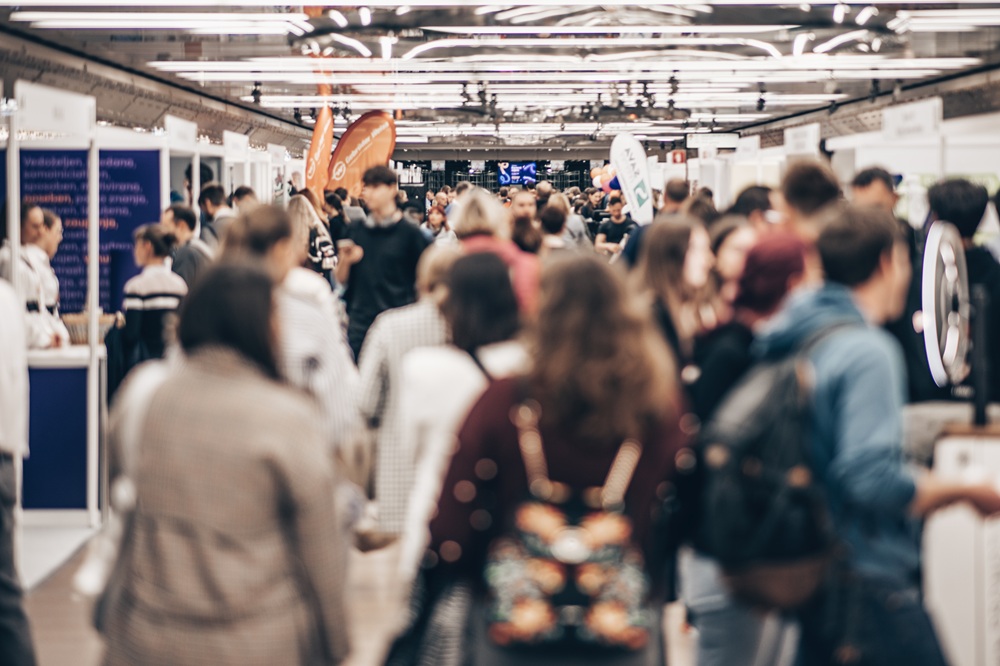
An aesthetically designed booth is never enough. If you want real, “convertible” foot traffic, you have to set up your booth with people’s behavior in mind. That is, where they look, what they notice, what stops them mid-walk.
This is where smart layout choices turn into better lead flow.
21. Anchor the booth with a clear visual magnet
What do people notice first when they walk the aisle? If you can’t answer that in two seconds, you’ve already lost them.
All of this to say you need a focal point that differentiates you from this sea of sameness and monotony. A moving element, oversized screen or an unusually shaped display can anchor attention instantly. Make it visible from 20 feet away.
22. Position interactive elements where they’re seen
A tad too many booths bury their best feature deep inside. If someone can’t see what’s happening without walking in, they won’t walk in. In essence, put your most engaging station at the edge. Let it speak for itself. People watching others interact will feel invited without being approached.
23. Use sightlines to guide attention and flow
It’s not about how big your booth space is but about what’s visible from where.
Make sure your booth isn’t a wall.
Open layouts, corner booth positioning and outward-facing visuals lure people in naturally. Use vertical space to create levels of interest. Also, avoid anything that blocks the view in or out.
24. Give the eyes somewhere to land
A cluttered booth is a forgettable booth.
Pick one central theme or message and build around that. Use lighting, spacing and movement to guide the eye through a narrative. And NEVER underestimate white space; it makes your content breathable and your message louder.
25. Avoid the dreaded U-shape trap
U-shaped layouts feel inviting to you, but from the outside, they look closed off. Visitors hesitate to “enter” because it feels like they’ll get claustrophobically cornered.
Flip the script: place your main engagement feature facing outward, then let them choose to step deeper in.
Build an Exhibit Booth That Pulls People In (and Keeps Them There).
Trade show success can be achieved by savvy exhibitors who understand their audience the best. As such, the winning booths are the ones designed for human behavior: Movement, curiosity, comfort, flow.
Use these 25 trade show booth ideas for design to rethink your layout, visuals and engagement strategy. When your space tells a story, invites interaction and respects dwindling attention spans, you’ll hands down have a booth people walk away from with your brand’s unique selling points stuck in their head.
Make your trade show booth the one people will remember most post-exhibition. Book a Padzilla demo today.


