
On the trade show floor, you have roughly three seconds to snag a lead’s attention before they drift toward the next booth’s free espresso bar.
Most exhibitors and marketers waste that window by plastering static, boring PDFs onto a monitor and calling it ‘digital content.’ It technically is, but if you want to stop foot traffic, like really stop it, you have to treat your content like an experience, not a lecture.
Let’s get to the matter at hand: mastering trade show marketing through your content.
Key Takeaways
- Go big or go home: Use life-sized displays to turn your product UI into a high-traffic spectacle that demands attention from across the hall.
- Stop pitching and start solving: Use ‘Choose Your Own Adventure’ menus to let potential customers self-segment and find the specific solutions they need.
- Gamify for quality: Replace generic giveaways with interactive challenges that force attendees to engage with your product’s value proposition.
- Control the comparison: Use interactive engines to tackle competitor comparisons head-on, building trust through transparency and bold positioning.
- Kill the paper brochure: Use ‘Digital Briefcases’ to send curated, requested content directly to a lead’s inbox, making sure your brand stays in their pocket.
- Pivot based on data: Treat your touchscreen analytics like a heat map – if a content piece isn’t getting taps by noon on Day 1, swap it for something that works.
High-Impact Visual Trade Show Content Strategy
Visuals are the frontline of your trade show booth. Before a prospect ever hears your elevator pitch, they’ve probably pre-judged your brand based off of the quality and scale of what’s on your screens.
To win, you need to move past the corporate slideshow mentality and start thinking about environmental dominance.
Three strategies to achieve this include the following.
1. Go big with life-sized interactive interfaces
Small monitors are for cubicles what giant displays are for closers.
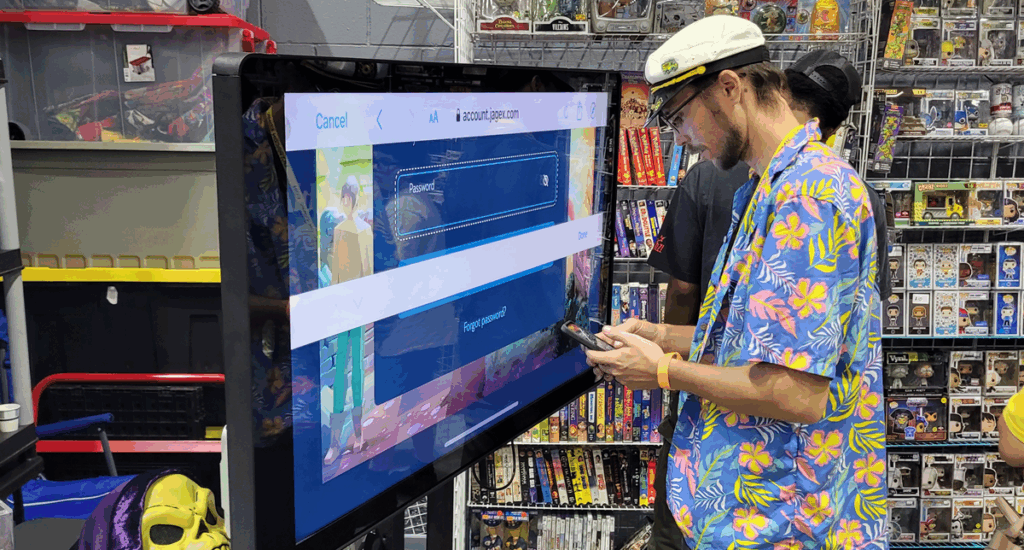
When you scale your software or product interface to a massive touchscreen, you transform a solo activity into a spectator sport. It allows passersby to see exactly how your UI looks and feels without having to lean over someone’s shoulder.
- Mirror the mobile experience: If your product or service is an app, display it at 10x the size so the UX is unmistakable.
- Encourage ‘Lean-In’ behavior: A giant screen invites people to physically touch the brand, which creates a much deeper psychological connection than watching a video loop.
2. Use kinetic typography to grab peripheral vision
Static text is invisible in a crowded hall. However, you don’t want a chaotic mess of flashing lights that looks like a 90s casino. Kinetic typography – text that moves in a deliberate, professional way – draws the eye without being an eyesore.
It’s highlighting your ‘Hero Claim’ so clearly that even the guy walking to the restroom knows exactly what problem you solve.
3. Prioritize high-contrast, text-heavy drive-by content
B2B trade shows and events are loud, both sonically and visually. Your content marketing must communicate your value proposition without needing a single decibel of audio.
With that said, use bold, high-contrast colors; think white text on dark backgrounds or vice versa to make sure your key messages are legible from 30 feet away. If a prospect has to squint to read your ‘Why Us’ section, you’ve already lost them.
Interactive Education and Engagement
The quickest way to lose a prospect is to talk at them.
The smartest way to keep them is to let them drive.
By turning your booth content into a self-serve discovery tool, you qualify leads in real-time and provide them with the specific information they actually care about, as opposed to a generic pitch.
4. Build a choose your own adventure menu
Every person who walks into your booth has a different pain point. Assume a CEO wants to see ROI; a manager wants to see ease of use; a developer wants to see the API docs.
Instead of forcing them all through the same deck, use your touchscreen to offer a ‘Who Are You?’ entry point.
- Segment by role: Create dedicated buttons for different job titles.
- Segment by pain point: Offer options like ‘I need to cut costs’ or ‘I need to scale faster.’
- The result: The prospect gets a tailored experience, and your sales team knows exactly which angle to take when they step in to help.
5. Gamify the discovery process
Stop giving away iPads for badge scans; it’s a lazy tactic that results in a CRM full of junk leads. Instead, tie your giveaways to an interactive challenge on your big screen.
Create a 60-second quiz or a ‘find the solution’ game that requires the user to actually engage with your product’s features to win. This makes it possible for anyone to walk away with your swag actually understanding what you sell.
6. Leverage social proof through interactive maps
A list of logos on a ‘Our Customers’ slide is easy to ignore. An interactive map that allows an attendee to tap their specific region and see a local case study is a POWERHOUSE move. It makes your global reach feel local and personal.
People trust their peers, and seeing a familiar company name pop up on a giant map creates an immediate ‘if it works for them, it works for me’ reaction.
Strategic Comparison and Live Problem Solving
Generic marketing speak doesn’t survive the expo floor. Attendees are in ‘comparison mode’ – they are literally walking from your booth to your biggest rival’s booth in the span of five minutes.
If your content doesn’t tackle their specific questions head-on, you’re leaving the door wide open for the competition.
7. Deploy an interactive comparison engine
Prospects are already comparing you to the other guys so you might as well control the narrative. Instead of dodging the “How are you different from [insert brand name]?” question, build a side-by-side comparison tool right into your touchscreen interface.
This shows supreme confidence in your product and saves the prospect the hassle of doing the research themselves.
- Focus on feature sets: Use a simple ‘Checkmark vs. X’ visual for easy scanning.
- The transparency win: Even if a competitor wins on a minor niche feature, showing where you dominate in the core areas builds massive brand trust.
8. Perform live audits and digital ‘sandboxing’
Implement the classic show, don’t tell strategy: Stop telling people what your product can do and start showing them what it can do for them.
Use your large-scale screen as a digital whiteboard or a live sandbox environment. If you sell SEO software, pull up their site. If you sell a UI tool, let them drag and drop elements on the gigantic screen.
9. Create a ‘Success Gallery’ filtered by pain point
Case studies are often buried in 15-page PDFs that barely anyone reads. On the floor, you need ‘snackable’ proof. In so saying, build a gallery where users can tap buttons like ‘Low ROI,’ ‘High Churn,’ or ‘Slow Deployment.’
When they tap, a 30-second video or a three-bullet-point slide pops up showing just how you fixed that specific problem for a client. It makes your success stories searchable and relevant to the person standing in front of you.
Seamless Transitions and Data Capture
The biggest failure in trade show history is the ‘Lead Black Hole’. It’s the gap between a great conversation at the booth and the follow-up email three days later. Your content should act as the bridge that moves the experience from your touchscreen to their pocket, all while giving you the analytics to know what they actually cared about.
10. Implement the ‘Digital Briefcase’ checkout
Paper brochures are trash (literally).
Most end up in the hotel bin before the keynote ends. Why not allow users to curate their own content experience on your Padzilla? As they browse videos or whitepapers, you can let them add these items to a ‘Digital Briefcase.’
Case in point:
- At the end of the session, they enter their email or scan their badge.
- The system instantly emails them a custom link with only the assets they selected.
- You now know precisely what topics that lead is interested in, making your post-show follow-up surgical rather than generic.
11. Utilize real-time heat mapping for content optimization
One of the most overlooked advantages of using interactive touchscreens is the backend data. Every tap is a data point. By the end of Day 1, you should be looking at your analytics to see which buttons were pushed the most.
For example. If everyone is clicking on your ‘Integration’ tab but ignoring your ‘Global Reach’ tab, move the Integration content to the home screen for the rest of the show.
Meanwhile, if people are spending a lot of time on the ‘Pricing’ page while your reps are busy, you know you need to loop back to those people immediately to talk value.
12. Bridge the gap with scan-to-mobile triggers
Your giant touchscreen kiosk rental is the ‘Hook,’ but their smartphone is the ‘Hold.’ Incorporate QR codes that aren’t just links to your homepage but triggers for specific actions, e.g., a “Take this product demo with you” QR code can launch a lite version of your software on their device as they walk away.
This keeps your brand in their hand as they navigate the rest of the convention center.
Level Up Your Trade Show Marketing Strategy and Stop Being a Background Character.
Don’t let your brand blend into the beige carpet and the hum of the HVAC.
The difference between a ‘good show’ and a ‘record-breaking show’ is how you bridge the gap between a passerby and a participant. By the time the lights go down on Day 3, you want to be the booth everyone is still talking about in the airport lounge.
Content is your hook, but interaction is your closer. If you’re ready to stop talking at your target audience and start letting them experience your product at scale, it’s time to change the interface.
Dominate your next trade show event! Book a Padzilla demo today and see how a giant touchscreen can transform your trade show ROI from standard to stupendous.rget audience and start letting them experience your product at scale, it’s time to change the interface.
Ready to dominate your next trade show event? Book a Padzilla demo today and see how a giant touchscreen can transform your trade show ROI from standard to stupendous.


